


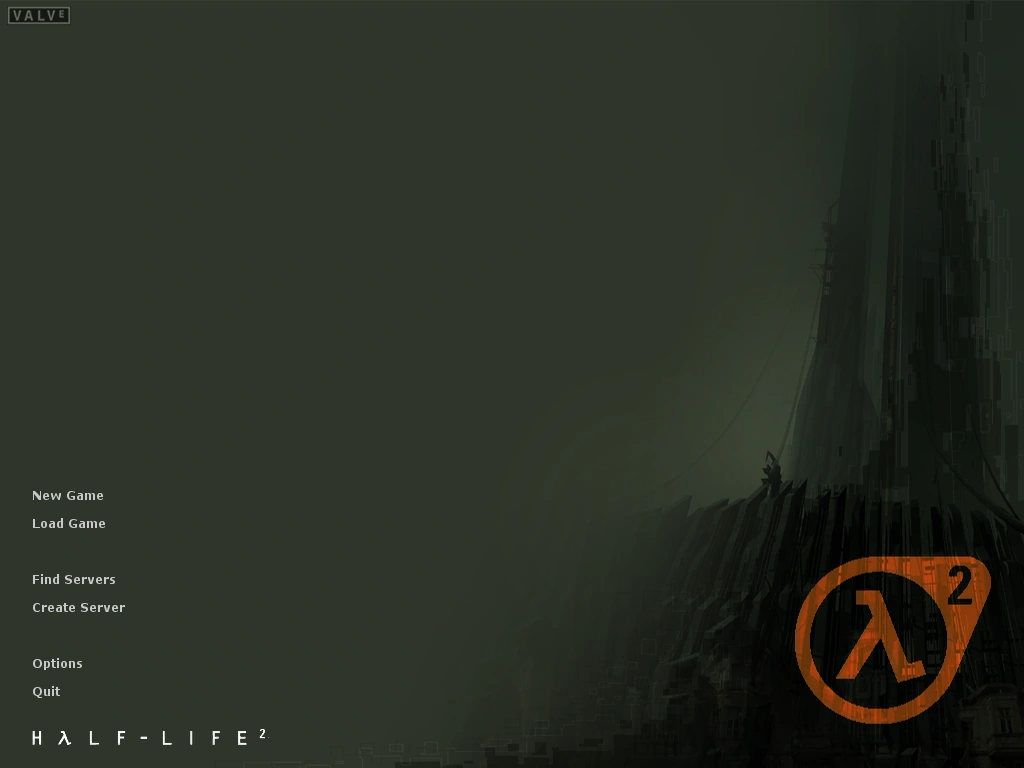
The Beta Half-Life 2 menu (2003).
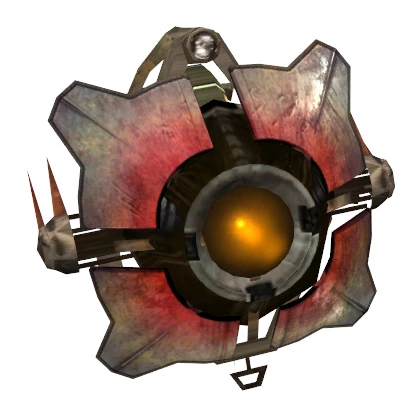
The Combot up close.
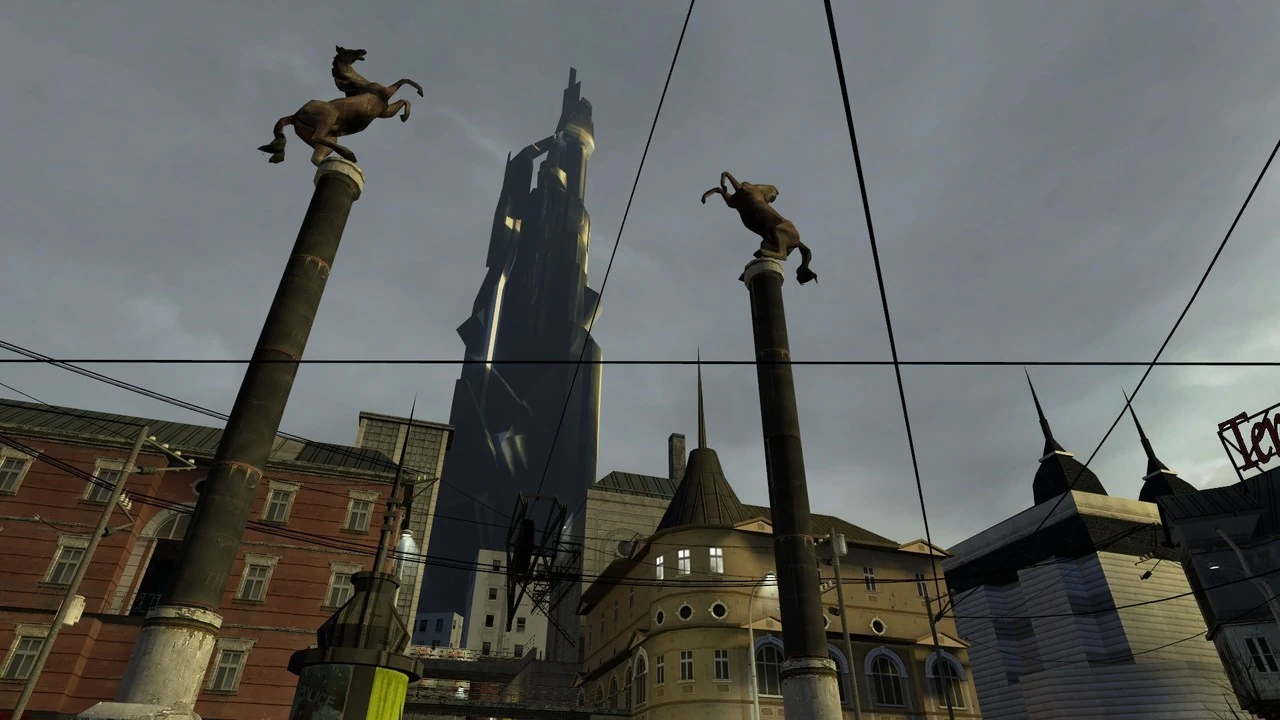
An early version of City 17 with the Citadel looking very different to its final.
The Half-Life 2 Beta, also known as the Half-Life 2 Alpha, the Half-Life 2 Leak, the Beta, or simply the leak, is a generic name that refers to Half-Life 2 during its interesting development stages, from 1999 to its release in 2004. Ever since circa 2018 the Project Beta team has created patches and in 2017 maps and models for the Beta using the source engine by the community and other modders.
Name[]
All names for the cut/leaked material were coined by the players. While "Half-Life 2 Beta" is often used for convenience, it is somewhat incorrect, since the leak files cover several stages of the game's development, spanning over years, and since no information about their different development stages is known except the engine build number. "The leak" would be a better title.
Original plot[]
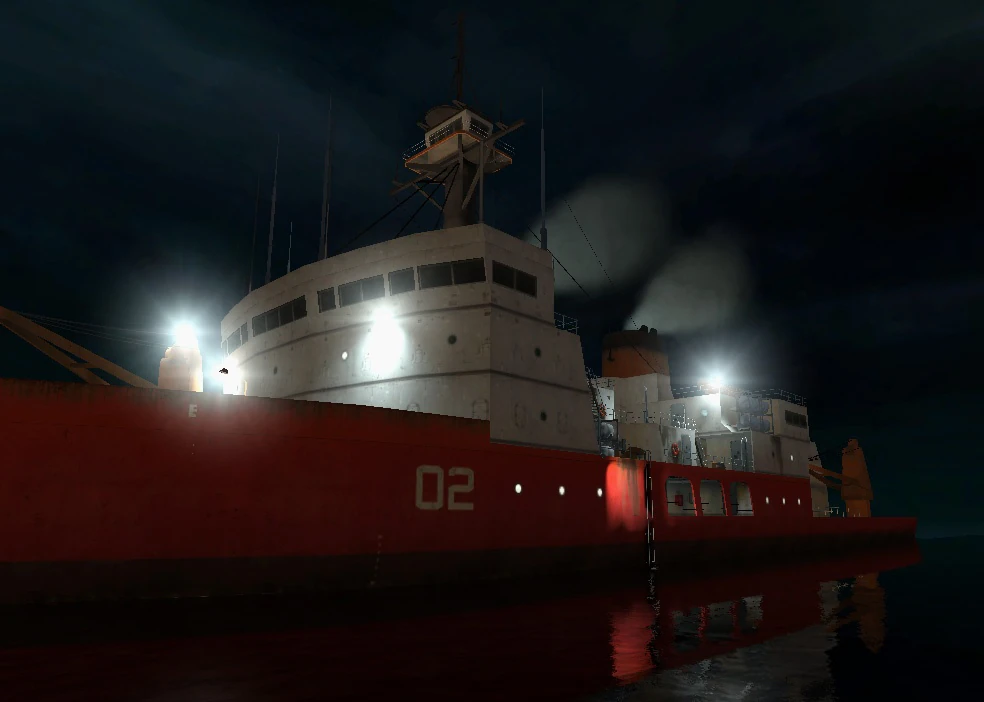
The Borealis.
The book Half-Life 2: Raising the Bar and the numerous leaked files revealed many of the game's original settings and actions that were either cut down or removed entirely from the final game. Half-Life 2 was originally intended to be a far darker game based on far grittier artwork where the Combine were more obviously draining the oceans for minerals and replacing the atmosphere with noxious, murky gases.
Half-Life 2 was also originally intended to be much more diverse in settings, and the original journey was extremely long (to the extent that the game felt almost overblown, with little time being spent on developing existing characters; one of the key reasons for it being cut). Several City 17 levels at the start of the game and complete chapters from the second half of the game were completely removed and sometimes re-introduced in the subsequent Half-Life 2 episodes.
Parts of the book Half-Life 2: Raising the Bar and the leaked files detail how Gordon would fight alongside characters such as Odell in the Borealis (or Hyperborea), as well as fighting together with Captain Vance and Vance's forces, the Conscripts, in the Air Exchange, the Weather Control and the rooftops of City 17. Originally, Eli and Alyx Vance had no relation, and Eli's lab was located in a cave in a scrapyard and was much rougher than the better-equipped laboratory within a hydroelectric power station in the retail version (the scrapyard area where the Gravity Gun tutorial takes place, being an auxiliary area as opposed to the bulk of the lab, is reminiscent of the original concept). The Citadel also looked very different, it was more round than the bulky Citadel from the final version.
Style[]
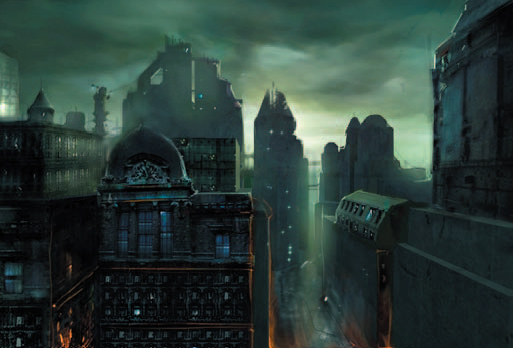

Concept art for the early City 17, with what appears to be the inner wall on the right.
While the playable game leaked in 2003 is quite similar to the retail product and already heavily trimmed, this earlier period of development of the game shows a quite different style. At this point, City 17 was an American East Coast-like city based on Washington, D.C.,[1] and Chicago, Illinois, with many large skyscrapers, and had a very basic, blocky FPS design.[2] It was more faithful to the concept art seen in Raising the Bar: darker, gothic, sinister, rainy, foggy, gritty, with a lot of brick, metal, and glass, getting along well with the cut concept of the Combine replacing the air with poisonous gas and draining the oceans. It was, therefore, a much more dystopian, Orwellian universe (even though the final product is still quite Orwellian) with touches of cyberpunk/steampunk style, in the vein of the book/film 1984 or other films such as Dark City, Blade Runner, City of Lost Children, and Avalon. It was also more faithful to Viktor Antonov's early concept art and work on the game.
The Combine was utilizing and recycling existent human materials and buildings instead of adding their own technology to them. This is why the early Citadel, for instance, had its walls covered with tiles.
During the time leading up to the 2003 leak, the team added more periods, such as the 30s, the 40s, and the 70s, eventually reaching the more Eastern post-Communist style seen in the retail version of the game, with older and smaller buildings and a bright universe instead of a dark one, which is more in the vein of the original Half-Life. The Ravenholm levels are a reminiscence of the original style even though the American East Coast-style skyscrapers were all removed.
Note that not all the concepts were present in the development process at the same time since the game had still a very rough, work-in-progress state.
Source code leak[]
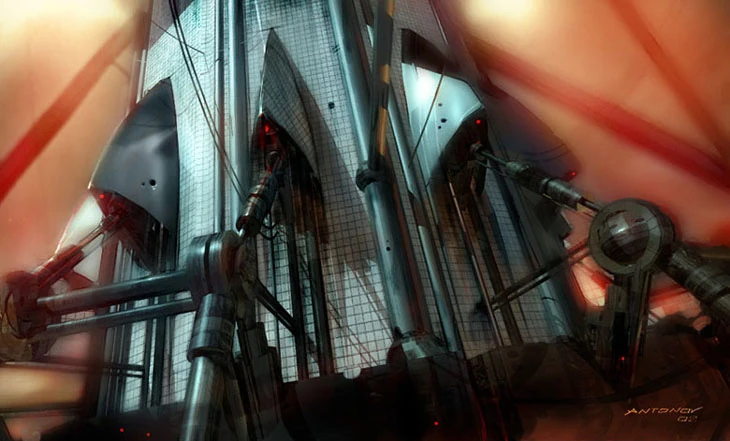

Pistons inside the Air Exchange.
Half-Life 2 was merely a rumor until a strong first impression at E3 in May 2003 launched it into high levels of hype, where it won several awards for Best in Show. It was scheduled for a release date on September 30, 2003, but was delayed. The pushing back of Half-Life 2's release date came in the wake of the cracking of Valve's internal network,[3] through a null session connection to Tangis which was hosted in Valve's network and a subsequent upload of an ASP shell, resulting in the leak of the game's source code on the Internet in early September 2003.[4] On October 2, 2003, Valve CEO Gabe Newell publicly explained in the HalfLife2.net forums the events that Valve experienced around the time of the leak, and requested users to track down the perpetrators if possible:
Ever have one of those weeks? This has just not been the best couple of days for me or for Valve.
Yes, the source code that has been posted is the HL-2 source code.
Here is what we know:
1) Starting around 9/11 of this year, someone other than me was accessing my email account. This has been determined by looking at traffic on our email server versus my travel schedule.
2) Shortly afterwards my machine started acting weird (right-clicking on executables would crash explorer). I was unable to find a virus or trojan on my machine, I reformatted my hard drive, and reinstalled.
3) For the next week, there appears to have been suspicious activity on my webmail account.
4) Around 9/19 someone made a copy of the HL-2 source tree.
5) At some point, keystroke recorders got installed on several machines at Valve. Our speculation is that these were done via a buffer overflow in Outlook's preview pane. This recorder is apparently a customized version of RemoteAnywhere created to infect Valve (at least it hasn't been seen anywhere else, and isn't detected by normal virus scanning tools).
6) Periodically for the last year we've been the subject of a variety of denial of service attacks targetted at our webservers and at Steam. We don't know if these are related or independent.
Well, this sucks.
What I'd appreciate is the assistance of the community in tracking this down. I have a special email address for people to send information to, helpvalve@valvesoftware.com. If you have information about the denial of service attacks or the infiltration of our network, please send the details. There are some pretty obvious places to start with the posts and records in IRC, so if you can point us in the right direction, that would be great.
We at Valve have always thought of ourselves as being part of a community, and I can't imagine a better group of people to help us take care of these problems than this community.
Gabe
In June 2004, Valve announced in a press release that the FBI had arrested several people suspected of involvement in the source code leak.[5] Valve claimed the game had been leaked by a German black-hat hacker named Axel Gembe, aka 'Ago',[6] born c. 1982. Gembe later contacted Newell through e-mail (also providing an unreleased document planning the E3 events). Gembe was led into believing that Valve wanted to employ him as an in-house security auditor. He was offered a flight to the USA and was to be arrested on arrival by the FBI. When the German government became aware of the plan, Gembe was arrested in Germany instead and put on trial for the leak as well as other computer crimes in November 2006, such as the creation of Agobot, a highly successful trojan which harvested users' data.[7][8][9]
At the trial in November 2006 in Germany, Gembe was sentenced to two years' probation. In imposing the sentence, the judge took into account such factors as Gembe's difficult childhood and the fact that he was taking steps to improve his situation.[10]
Although Valve has never made any official statement about how the leaked files should be considered and used by the community, no actions have been taken against websites or people using and hosting leak-related content. Valve-sanctioned websites and games such as Garry's Mod host material related to the leaks and discussing it is not forbidden on the website's Facepunch forums (which was forbidden in the past). The general consensus would then be that Valve is not preoccupied anymore with the use of these leaked files and their use and distribution is not forbidden although not blessed, as long as they are used for free; when asked to Valve by e-mail on July 20, 2009, about the status of the Beta-based mod Missing Information, the answer was that "the mod is not illegal to download and play as long as it is just a mod."
Leaked files[]
Playable game[]
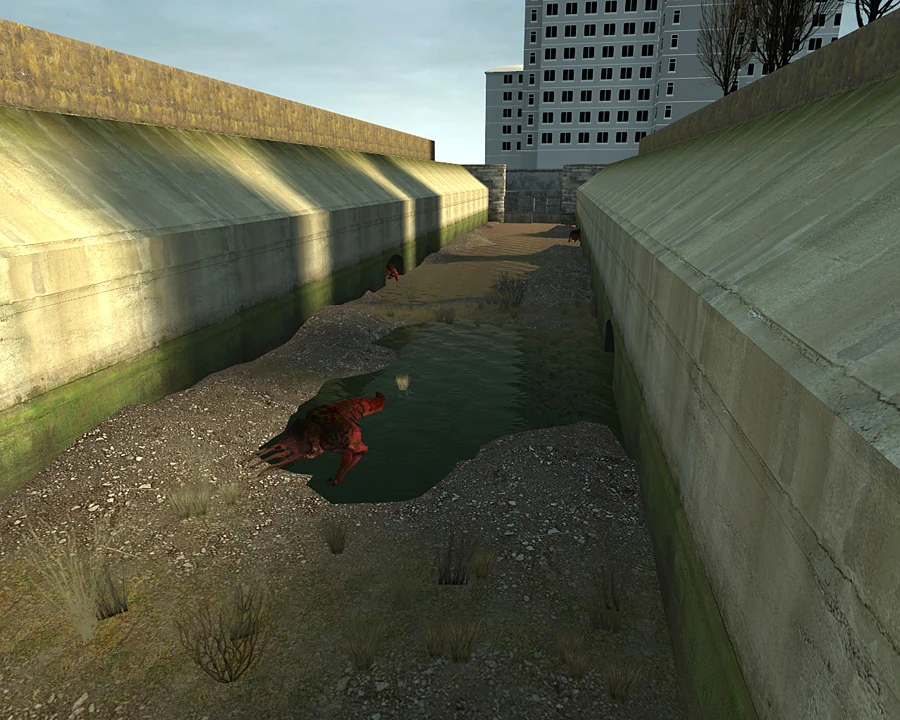
Bullsquids in the Canals.
The files leaked in 2003 consist of a playable game available in two versions, the "anon-hl2" leak and the "Russian" leak, both of which slightly different from the other. The "Russian" copy of the leak is based on the original 100 part leak "anon-hl2". One of the few notable differences between the two is the presence of an installer, while the "anon-hl2" leak consists of 100 .rar files. The "anon-hl2" beta contains at its root a .txt file last edited in October 2003, with these words:
Just create a server to play.
in the console, use "noclip" when it's stuck.
Really full of bugs, sure that valve won't release it before a while.
Have fun !!!
The work-in-progress nature of the game makes it obviously very incomplete and quite unstable with some maps even failing to load. At the time of the leak chapters such as the Air Exchange, the Borealis, and the Skyscraper were already cut and City 17 already had its Central/Eastern European style, making the leak very similar to the final retail product and representative of what Half-Life 2 looked like in 2003. Therefore, the cuts were not made because of the leak, but for other reasons, and much earlier in the development process.
Features from the playable game[]
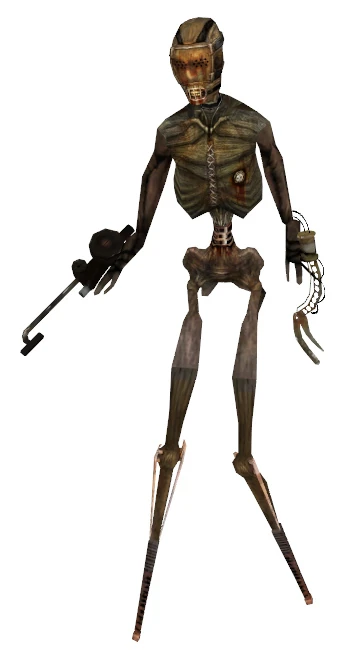
The Stalker as seen in the playable game.
- The interface appears to be based on the Steam version of the first Half-Life. For example, it has "Software," "OpenGL," and "DirectX" listed as usable renders in the "Video" tab, but the Source engine used DirectX only when it was released.
- There is extremely basic multiplayer support. It can support very few players. Interestingly, one of the tabs in the "Create a server" option is named "CPU Players."
- It is, however, quite difficult to follow the incomplete storyline, as several maps won't load and crash the game. The causes of the crashes are due to these maps being very old for the branch that the leak is running on (from 1999-2001 was a very early alpha of the Source Engine which is basically another version of GoldSrc with physics).
- There is basic DirectX 6 support, which consists of a few low-poly character models and a DirectX 6 version of one of the Coast maps.
- The engine is, of course, less optimized than the one used in the final game.
- There is no built-in anti-aliasing. It can, however, be emulated with the most recent graphics cards that override the game's settings.
- The source code contains a folder called 'ivp' (IVP stands for Ipion Virtual Physics, a physics engine from Ipion Software that was bought out and brought into Havok 1) which contains Source's original physics engine from early 2001 containing IVP code (dating from 1999–2000) incorporated into the Havok code. The VPhysics engine based on Havok 2 is also present in a separate folder and is the final version retained in the Source engine.
- The leak uses a unique ammo system not seen in the final version. Ammo is broken up into three types; small, medium, and heavy. The SMG2 uses small; the Pistol, SMG1, AR1 and OICW use medium; the HMG uses heavy.
- The Colt Python and Resistance Crossbow were not implemented in the game at the time of the leak, and as a result, do not exist in the playable prototype.
- Several sound files from chapters already cut in the playable version can still be found in the sound folders, such as early Breencast clips by the Consul, Conscripts dialog involving an Overwatch Sniper, Overwatch Soldiers chatting in the Skyscraper, a scripted sequence involving three homeless Citizens (nicknamed "hobos," one of them named "Regis") talking about Vienna sausages (one of the them has the same voice as Odell) in a City 17 underground prototype (in the maps "
vienna_talk" and "vienna3," last edited in 2003),[2] a scene involving Alyx (voiced by another woman) and a Strider chase, and dialogues and music from the film Aliens, to be used for lip sync tests in the maps "aliens_test" and "testroom_ripley" (the dialogues) and the surreal map "ickypop" (the music).[2][11]
NPC differences[]
- Citizens have different models and facemaps, most of their Idle Voicelines voiced by Marc Laidlaw and they only can use the Stunstick, SMG1 and OICW *Only used once*
- Civil Protection were simply called cops by citizens. Although they have early voice lines, they only say Idle Statements and don't talk to the Overwatch Voice.
WC mappack[]
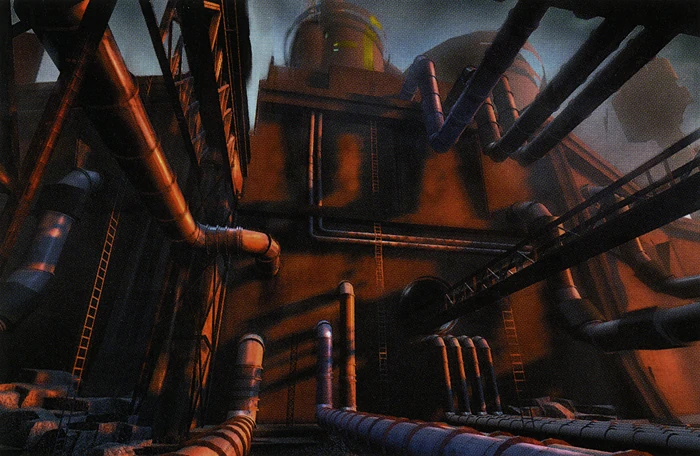
Concept art for the Air Exchange, based on a map from the WC mappack.
Other files consisted of a group of several zip files nicknamed "WC mappack" (WC stands for WorldCraft, the early name for the Hammer level editor), containing around 1300 incomplete VMF maps (VMF stands for "Valve Map File") of the very early chapters already cut in the playable game mentioned above (most of them are repeated and almost identical), demo/prototype maps and the maps from the playable version, spread in around 60 folders named by the developers who worked on them, taking up around 3 gigabytes. These maps can be opened in Hammer and can be run in any Half-Life game after texture fixing (since several textures can be missing, especially the original Combine metal variations) and compiling them into BSP maps (using the option "Create a Mod" in the SDK and putting the textures from the playable Beta in its folder will do most of the preliminary work, as most of the textures will be missing if the compiled map is played on the released game). The maps still have the date they were last modified, which can give other clues about the game development. Most of the maps are very old and were last edited/created in 2001 or 2002.
The leaked files available on the Internet are obviously only parts of the original files used in the development of Half-Life 2, since many more maps, models, sounds, scripts, and textures exist, as well as more than 50,000 reference photos taken in the USA and Europe used for design inspiration.[1]
Cut features[]
Weapons[]
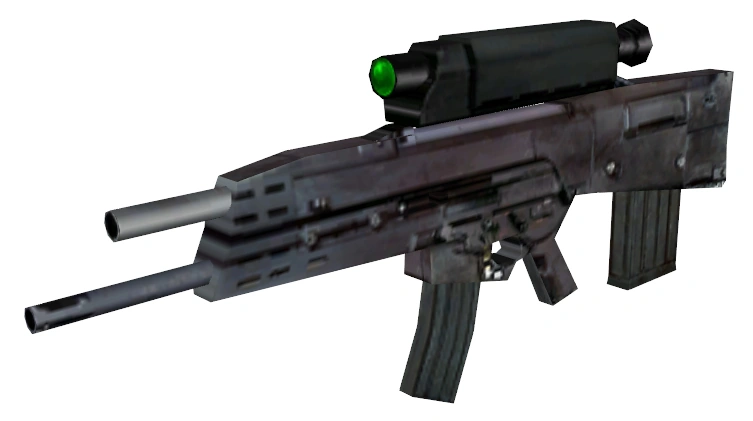

The XM29 OICW.
Throughout the development of Half-Life 2, its impressive arsenal of weaponry varied considerably and it contained several different weapons than when the game was first made public, weapons that were later cut before the final release.
It has been suggested that the bulk of the weapons were cut due to the fact that they were too similar to one another, as the AK-47 served a very similar role to the AR2, and the OICW the same to the SMG1, and that it would not be very believable to hold more than 25 weapons. However, a limited weapons system was implemented at some point, having the player throw a weapon before picking up a new one.[12]
Most, if not all of these weapons are usable in the playable Beta and the mod Missing Information, although sometimes with changes.
Vehicles[]
- AirEx Truck (as a static prop)
- Digger
- Jet Ski
- Israeli Merkava (used by the conscripts)
- VAB APC (also used by the conscripts)
- Van Car
Friendly fire[]
Half-Life 2 originally featured friendly fire, as with Half-Life. Valve found this to be annoying to playtesters, as they would often accidentally kill their team-mates, and was therefore changed so the weapons do no damage to team-mates. In the retail game the friendly fire code is still intact.
Cut enemies[]
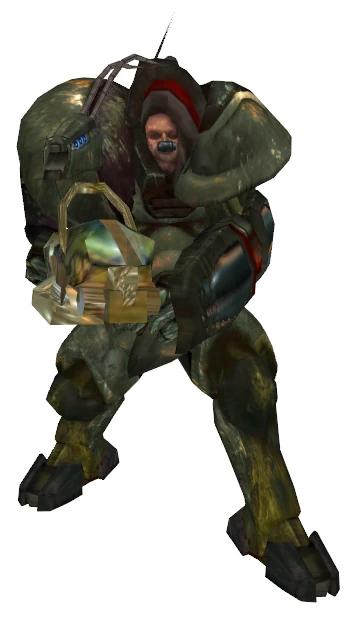
The Combine Guard.
Many enemies were cut. The most prominent ones include:
- The Combine Assassin. A female soldier, the successor to the Half-Life Black Ops.[1] She is included in Half-Life 2: Survivor.
- The Combot, a predecessor to the City Scanner. It is slightly more aggressive than the City Scanner: it is equipped with a flamethrower and causes a bigger explosion when performing its suicide attack. However, it does not flash at the player.
- The Alien Assassin, a humanoid creature dressed in black that would behave like a stereotypical ninja. It can be presumed through cut animations that it was to drop smoke grenades and throw Hopwire Grenades. Parts of the AI were reused for the Fast Zombie.[1]
- The Bullsquid. It behaves exactly like the one from the original Half-Life but has reddish skin. One of the leaked maps set in the City 17 canals has a section designed around swimming Bullsquids, but they will never enter the water. There was also going to be a variant with a more yellow-ish color.
- The Houndeye. It was to behave similarly to the one in the original Half-Life, but there was to be more emphasis on the Houndeyes behaving like a pack of wolves. Its leaked model is corrupt, but its textures are still viewable.
- The Cremator. It would clean the streets of bodies after a skirmish with a massive acid gun called the Immolator, which would double as an offensive weapon when the Cremator would become an enemy. It has no AI in the leak.
- The Hydra. The Hydra is a long, blue tentacle with a long needle on the end. While impressive to view, the Hydra was much less interesting when actually fighting against it. It's an interesting NPC in the sense that it lacks any animations and all movement is handled by the code. However, when it was showcased at E3 2003, the model was animated specifically for viewing at the event.
- The Combine Guard. The Combine Guard is a giant transhuman soldier that wields a weapon called the Combine Guard Gun. The gun is essentially a portable version of the Strider's laser. The Combine Guard only appears in "
e3_terminal," but it can be spawned anywhere and is invulnerable; its AI is reused for the Hunter in Episode Two but is heavily modified.
Cut locations[]
The fate of the cut material[]
Although most of these concepts were cut from the final game, many of them eventually made it into future releases.
Half-Life 2 (retail)[]
- The concepts of the Overwatch Elite gathering all of the elite units, notably the Combine Super Soldier and the Combine Assassin.
- The Alien Assassin was recycled into the Fast Zombie.
- A Cremator's head can be seen in Eli's Lab, placed in a jar.
- Ravenholm was originally located at the end of the canals and before Eli's lab. It featured a lake at its foot, with at least one Ichthyosaur. This lake and the small docks were somehow kept for Black Mesa East when the chapter order was reversed, and the Ichthyosaur makes its only appearance during the teleportation failure at the start of Half-Life 2.
- Odell's model was used and reworked for Odessa Cubbage.
- One of the Borealis' door props is used as an entrance door for the Vortigaunt Camp.
Lost Coast[]
Lost Coast was based on a chapter cut from Half-Life 2 and was finally released as an HDR technology demo. None of its material, however, can be found in the leaked files, suggesting it was implemented after the leak but removed before the retail release.
Half-Life 2: Episode One[]
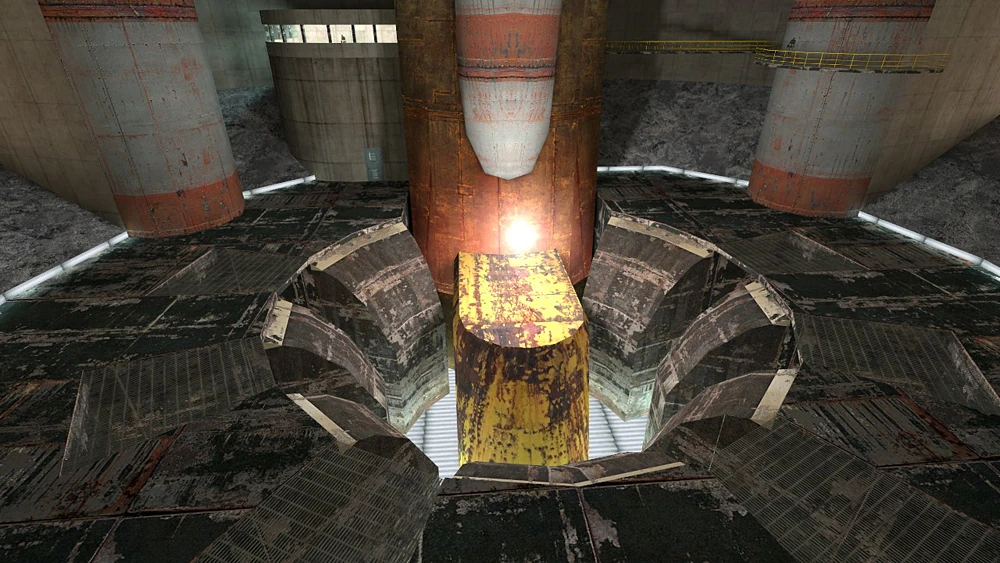
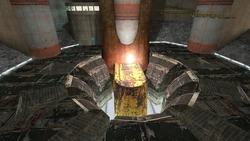
An early version of the Citadel Core.
- The exposed head of a (Bloody) Standard Zombie was originally going to have a half-skull, with only the jaw part intact, as seen in the playable leak. This concept (the idea that a headcrab could remove the head of its victim) was recycled for the Zombine.
- The Zombine itself was to originally appear in Half-Life 2, based on the remaining text files.
- The Air Exchange train wreck[1] was reused at the start of the chapter Lowlife.
- The huge destroyed concrete level at the start of Vertigo seems to have been reused in the City 17 Underground in the chapter Lowlife, where Gordon and Alyx are fighting Antlions and Gordon must find cars to block the Antlion holes.
- The Stalkers, originally to be fought in Half-Life 2, are at last directly confronted in Episode One.
- The Citadel Core was to appear in Half-Life 2, as a prototype map exists in the WC mappack.
- The Advisor room. The tube used by Advisor Pods to leave exists in a very old WC mappack map.
- Judith Mossman wearing a winter coat in an Arctic setting appears to be recycled from her predecessor, Helena Mossman.
Half-Life 2: Episode Two[]
- The Air Exchange train wreck[1] was reused at the very start of the game, while at some point wrecked train cars in a valley were to be seen at the end of the Canals before Ravenholm, somehow recycled for the start of Episode Two.[2]
- The Antlion caves:
- The Antlion Grubs were to be met in the caves.
- The Antlion King that was also to be met in the caves was recycled into the Antlion Guardian.
- Some mining themes cut from Ravenholm, such as carts, were reused for the Victory Mine area.
- The Combine Guard AI was recycled for the Hunter.
- The Hopwire Grenade's purpose and function are reused for the Magnusson Device.
Half-Life: Alyx[]
- The unused 'pale' synthetic skin for the Strider seen in some early concept arts was finally used as the early variant for construction striders, as seen in the first chapter.
- Odell's overall model and some personality traits are seemingly reused and improved for Russell as seen in-game.
- One of the new Combine soldier types, the Combine Suppressor, appears to take inspiration from the earlier Metro Cop and Elite Metro Cop's old helmet designs.
- The City 17 beta logo symbol can be seen in a black and white variant.
- Eli Vance's predecessor Eli Maxwell's Black knit/watchers' or beanie cap is reused as part of the younger Eli Vance's attire.
- The old mortar sounds heard in the leak and E3 2003 trailers for the Manhacks are half-reused during gameplay shootouts.
- The Cremator's original purpose as the 'cleanup' passive enemy has been reused and expanded upon via the Combine Workers and the Combine Hazmat Workers. However, most of them are never encountered alive in-game, instead only appearing as corpses and in Zombified forms. The Final Hours of Half-Life: Alyx showcases concept art of the Cremator, suggesting that it was also cut from Half-Life: Alyx.
- The Xen Grenade’s organic appearance is very likely inspired by the Hopwire Grenade’s appearance.
- The concept of visiting City 17's Industrial side is brought back for chapters 6 and 7.
- The idea of Xen fauna slowly taking over the City's landscape was revived and hugely expanded upon, and plays a major part in the game's story.
- The Vorti-Cell's concept and purpose are recycled through the Combine's use of modified Combine Cells to harvest energy from captive Vortigaunts.
- Alyx's Apartment in the very beginning of the game seems to be based on a reference to Alyx's cache in the leaked sound files.[13]
Mods[]
Since the release of the retail game in 2004, many attempts have been made to restore the original storyline by making mods based on the leaked files. Some mods never went further than rough development stages and some fixes, some are still in development. Some players have fixed several maps without including them in a full game. These can be found across various websites online.
One of the most famous mods based on the Beta, the only to have ever been released, albeit in an incomplete stage, is Missing Information. Though originally considered "illegal content" by Valve, the mod has since been considered legal as long as it is distributed for free as a mod and does not use the original source code. The mod's current version includes the E3 2003 and the Borealis chapter, though quite incomplete, and another release is expected soon. Other unreleased mods include Half-Life 2 (GabeN), Half-Life 2: BetaSource, Dark Interval, CASTE, Raising the Bar: Redux, and Project-9 (see Mods based on the Beta).
E3 2003[]
Several demos of work-in-progress levels were shown at E3 2003.
List of demonstrations[]
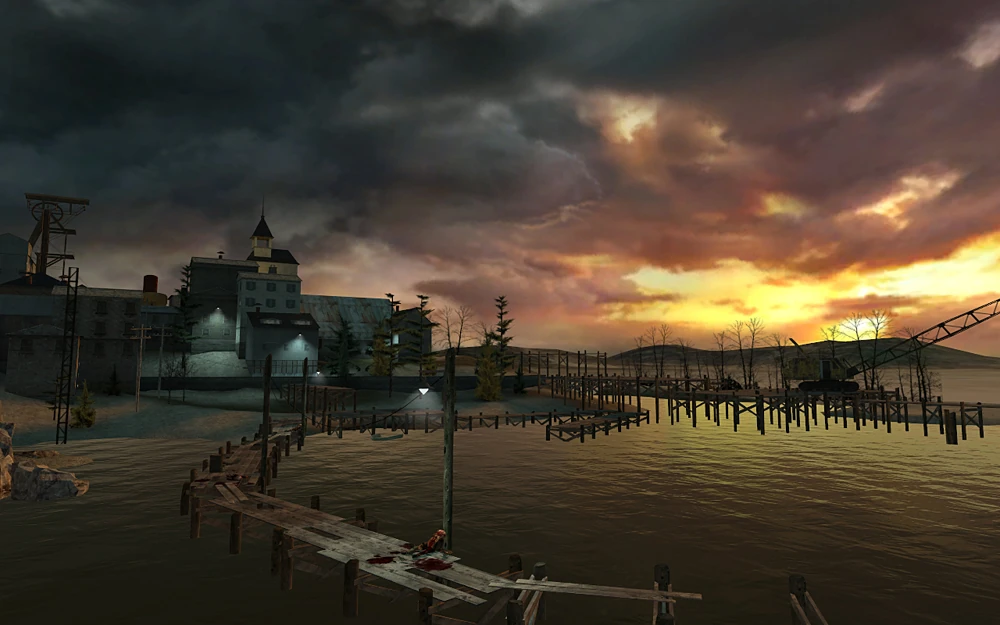
The Traptown docks as seen in the E3 2003 presentation.
- A trailer (featuring very early footage)
- "G-Man" (facial animations)
- "Docks" (featuring early docks near Ravenholm)
- "Kleiner's Lab" (featuring an early Kleiner's Lab sequence)
- "Tunnels" (featuring sewer areas partially recycled for the late chapters of Half-Life 2)
- "Bugbait" (featuring a daytime Nova Prospekt)
- "Barricade" (featuring a street battle against Metrocops, with Barney and Rebels)
- "Coastline" (featuring an early Dock 137 sequence)
- "Psyche" (a dream-esque sequence featuring the G-Man and other pictures)
- "Striders" (featuring a Rebel battle against Striders)
The original demos, .cfg files used to record the demos and .bat files (demoloop.bat) used to start the demos played at E3 are included in the 2003 leak, but there are so many differences between the engine used at E3 and the leaks that it is impossible to play them.
Something notable is the fact that all of the 2003 leaked Beta demonstrations are broken in one way or another. Most stem from missing models and incorrect usage of props (ex. the game uses a prop_physics for a model when the engine only thinks that prop can be prop_static, so it deletes it). Almost all the presentations have been fixed and included in the mod Missing Information.
- The G-Man emotions demo will not work, as the Half-Life G-Man model produces an error, thus preventing the movie from even starting.
- The Source engine demos are greatly affected by certain models being the wrong version; most of the revolving slabs at the start will turn into error signs. The camera is broken, as it faces only one direction. The G-Man immediately dies when spawned, and the camera will not change direction when the Headcrab knocks it over. The ground eruption at the start of the physics demo never works, but that demo is otherwise the same.
- Kleiner's Lab is also extremely broken; Alyx and Kleiner do not walk around and their lips do not move. In addition, most of the dialogue is not in the game, generating a large amount of errors. However, the player can still watch the Strider blow up the wall and get the SMG from Alyx, even though she lacks the "give the player the SMG" animation.
- Traptown is as well extremely broken. The metal bars that are supposed to hit the soldiers about halfway through the demo are released as soon as the map begins because the game deletes the objects restraining it. The "Troop forcing open the door" scripted sequence only works about half of the time, the soldier on the third floor of the building never appears, the player can hear distorted music in the building, the radiator constraint is broken, tossing a grenade under the trash can will crash the game, and the blade trap at the end does not work.
- Coastline is the only demo that is still in good shape, but it lacks a sound effect (a soldier saying "Stop!" as the player gets near the back of the harbor). Otherwise, it functions as it should.
- The Psyche demo works except for the non-pre-cached G-Man voice and obsolete "env_fov" entity that was replaced with "env_zoom" in the retail release and the playable Beta.
E3 demonstrations cut from the final game[]
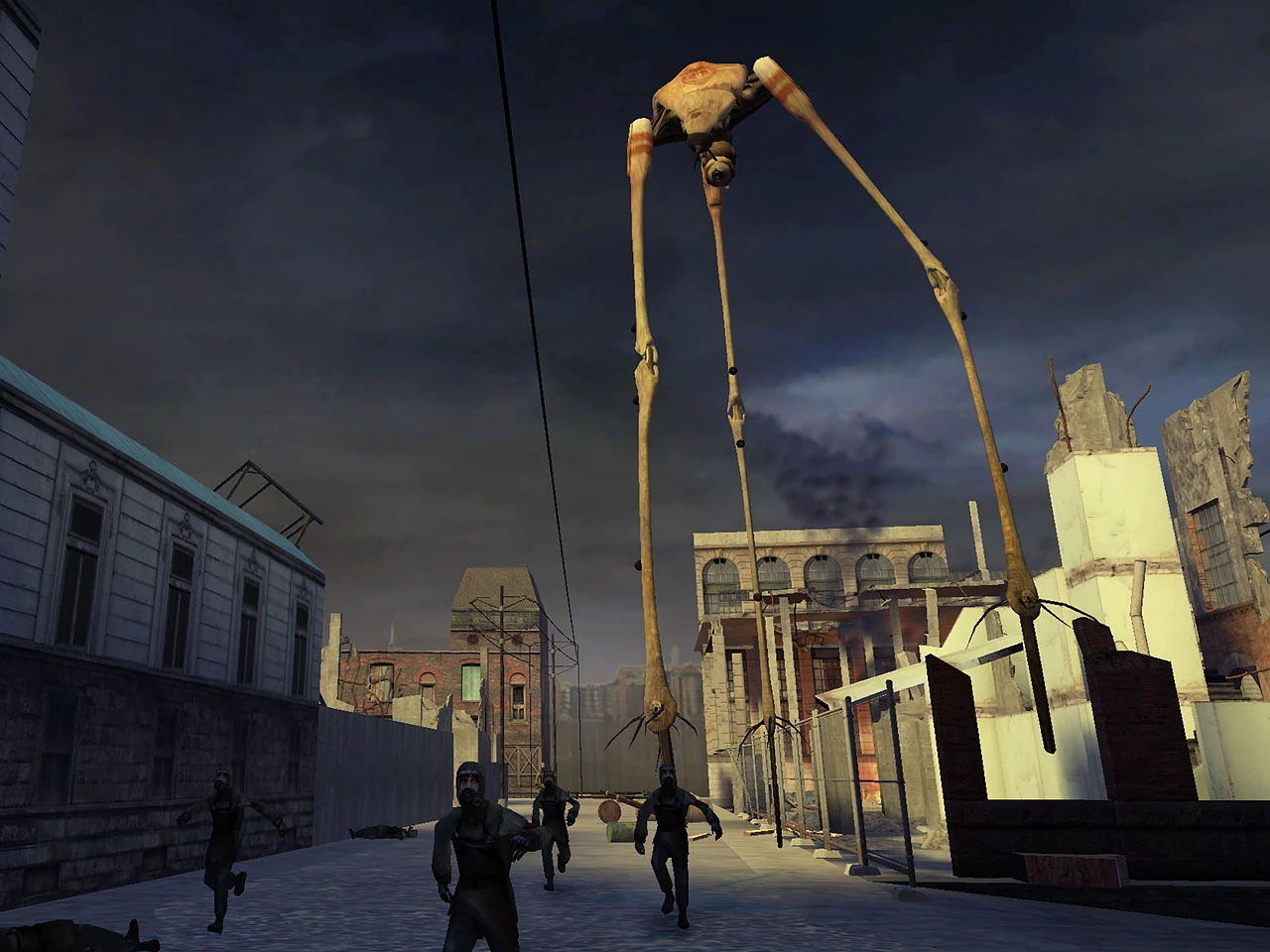
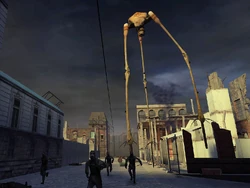
Citizens fleeing from a Strider in the map e3_strider.
Many E3 2003 demonstrations never made the cut either. The most popular among users, found in the 2003 leak as unfinished maps, are:
- Terminal, whose remnants can still be found today on the Half-Life 2 box art. It was also used in the Half-Life 2 teaser trailer. The column that's mounted by a horse statue, however, made the final cut in the map preceding Gordon's first travel into the Citadel.
- Industrial, which featured an extremely early concept, the Combine Factories, featuring children.
- Depot, a map featuring parts of the Wasteland area surrounding the Depot and a lighthouse. The Depot was kept for the Nova Prospekt level while the lighthouse is featured in the rebel base Lighthouse Point.
Some other maps, which are incomplete, are:
- Strider, which was actually almost complete, with the exception of missing scripts which makes it unplayable. Some parts of it were later recycled for use in the Hydra demo. One of the earliest official Half-Life 2 screenshots shows the functioning map. It is one of the only pictures which showcases a group of citizens with gas masks when the Air Exchange was still in the storyline intoxicating the air. It was also used in the teaser trailer. Its design was based on the very first Half-Life 2 demo, Get Your Free TVs!.
- Sniper, which began as a player running through a ruin-covered street to kill a sniper. This is also the earliest leaked map that utilizes the sniper.
- Ship, showing the player on the Borealis. It starts off with climbing a ladder, then shows struggling with some fast Headcrabs before entering a corridor and finally reaching the deck where a Gunship appears. After this point, several explosions are encountered. This could possibly be the gunship doing damage.
- Town, which was a much longer version of the E3 2003 map "Docks" featuring a player going through Ravenholm. However, Grigori is not seen at all. It ends with a building exploding triggered by a zombie.
The E3 preview of Gordon visiting Kleiner's Lab after returning from Nova Prospekt with Alyx contains a different dialogue between Alyx and Kleiner than in the version viewable online: it shows a slightly different design for Alyx and ends with the lab being attacked by Striders, an event that does not occur in the final game.
Gallery[]
Menu[]


Trivia[]
- Half Life 2 was originally meant to take place in Chicago, USA.
- Gordon Freeman was meant to travel to other worlds and eliminate the Xen forces on said worlds.
References[]
 The Half-Life Wiki has more images related to Half-Life 2 Beta. The Half-Life Wiki has more images related to Half-Life 2 Beta.
|
- ↑ 1.0 1.1 1.2 1.3 1.4 1.5 Half-Life 2: Raising the Bar
- ↑ 2.0 2.1 2.2 2.3 WC mappack
- ↑ Half Life 2 Source-Code Leak Delays Debut. TechNewsWorld. Retrieved on February 14, 2007.
- ↑ Playable Version of Half-Life 2 Stolen. CNN Money. Retrieved on February 14, 2007.
- ↑ 'Phatbot' man linked with Half-Life 2 leak. play.tm. Retrieved on February 16, 2007.
- ↑ Valve and FBI faked interview to lure hacker to US on Geek.com
- ↑ Infosecurity 2008 Threat Analysis, page 16, ISBN 1597492248 ISBN 978-1597492249
- ↑ How Legal Codes Can Hinder Hacker Cases - WSJ.com. Online.wsj.com. Retrieved on 2008-09-21.
- ↑ http://wsjclassroom.com/archive/05feb/onln_hacker.htm Hacker Hitmen - Cyber Attacks Used to Be for Thrill Seekers. Now They're About Money.
- ↑ How Legal Codes Can Hinder Hacker Cases. Wall Street Journal Online. Retrieved on April 12, 2008.
- ↑ Playable Half-Life 2 Beta files
- ↑
 Half-Life 2 at E3 2003: Coastline on YouTube
- ↑ Alyx's Apartment

See also[]
See these related articles for more information on the early Half-Life 2.
External links[]
Misc.[]
- "I need the assistance of the community" — the original thread created by Gabe Newell on ValveTime (Archived)
- The Truth Behind The Half-Life 2 Robbery on Rock, Paper, Shotgun


Beta footage[]
- Half-Life 2 E3 2003 Tech Demo on YouTube
- Half-Life 2 E3 2003 Trailer on YouTube
- First sight of the Source engine at E3 2003, part 1 on YouTube
- First sight of the Source engine at E3 2003, part 2 on YouTube
- Gameplay in various maps on YouTube
- Video of the original Kleiner's Lab sequence (test) for the Beta-based mod Dark Atmosphere on RuTube
Mods based on the Beta[]
- Beta Project (Russian website providing several mini mods and single maps released from time to time)
- Missing Information (currently at version 1.6, still in progress and has a steam page)
- Depot
- Minimalist Mod (parody mod powered by Xash3D)
- Operation Reclaimation (still in progress)
Currently in development[]
- Dark Interval
- Cremation
- Half-Life 2: Raising The Bar Redux
- Episode 17
- Project Interceptor: Untold Story
- Half-Life 2: The Abyss
- Hyper
Discontinued/Dead/On Hold/Inactive Mods
- Raising the Bar (Discontinued since Oct. 2016)
- Der Shwarze Nebel (Last file uploaded in Sept. 2017)
- Air Exchange (Archived on ModDB since 2010)
- Russian-Anon (Last Article validated in 2010)
- Project: Hyperborea (On Hold according to the Developer)
- Beta Complete (No Files even thought stated as "released")
- Old Times (Ceased development sometime in 2018)
- Old Story (Last image uploaded in 2012)
- The Fallen Warriors (Inactive or Dead since 2015)
- Insolence (Migrated to Terminus, who's last article was in 2014)
- The Origin (Website no longer active, last comment from Dev was in 2018)
- Project-9 (Website no longer active)
- Half-Life 2 Beta Deathmatch (Last build uploaded in 2014, source code released in 2016)
- Half-life: Ablation (ModDB page down)
| Real-World subjects | |
|---|---|
| Companies | Gearbox Software • Junction Point Studios • Valve Corporation |
| Production staff | Artists • Character models • Composers • Voice actors • Writers • Other |
| Software | Achievements • Compilations • Demos • Games (Half-Life • Multiplayer • Non-canon • Portal • Third-party) • Game Engines • HL HD Pack • Mods |
| Other Media | ApertureScience.com • Books (Lab Rat • Raising the Bar) • Fan content (Films • Games • Mods • Series) • Films • Merchandise • Preliminary Findings • Soundtracks (Songs • Composers) • The Final Hours (Half-Life • Half-Life 2 • Half-Life: Alyx • Portal 2) |
| Cut content | Prospero • Half-Life Alpha • Half-Life 2 Beta • Half-Life 2: Episode Three • Half-Life 2: Episode Four |
| Misc. | Canon • Development (Commentary • Half-Life 2 • Portal • Next Half-Life game) • Mr. Valve • Retcons |